HEPA vs. Activated Carbon Filters
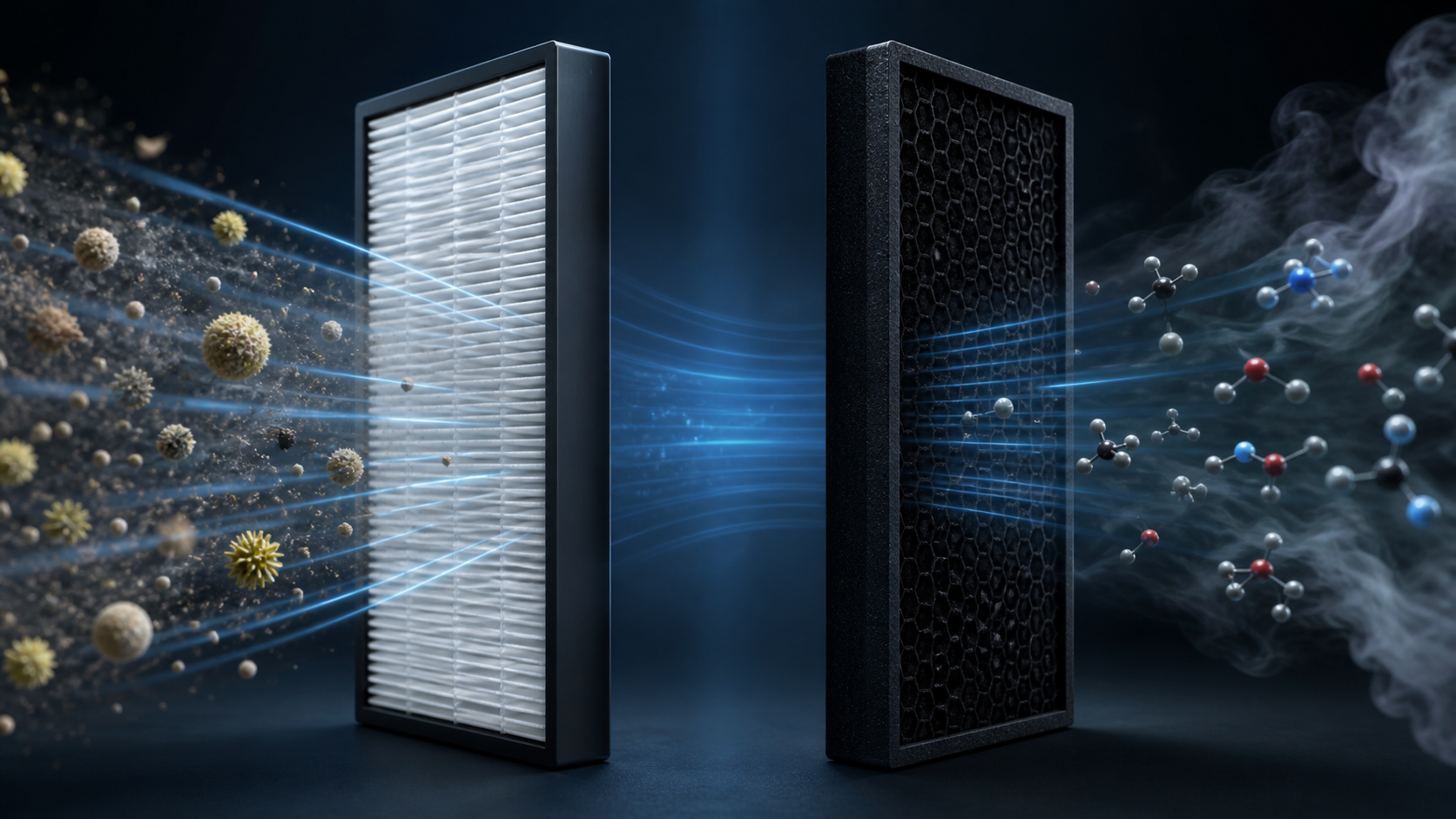
One of the most common mistakes in air purification is assuming one filter does it all. In reality, HEPA and Activated Carbon are two completely different technologies designed to solve two completely different problems.
HEPA Filters: The Particle Specialist
HEPA stands for High-Efficiency Particulate Air. A True HEPA filter is made of a dense mat of randomly arranged glass fibers. It works by trapping solid particles through three mechanisms: interception, impaction, and diffusion.
- What it captures: Dust, pollen, pet dander, mold spores, smoke ash, and fine particulate matter (PM2.5).
- What it misses: Odors, gases, chemicals, and VOCs.
The Takeaway: If you have allergies, pets, or asthma, HEPA is your most important component.
Activated Carbon: The Gas Specialist
Activated carbon is charcoal that has been treated with oxygen to open up millions of tiny pores between the carbon atoms. This creates a massive surface area—just one gram of activated carbon can have a surface area of over 3,000 square meters. It works through adsorption (not absorption), where gas molecules stick to the surface of the carbon.
- What it captures: Cooking odors, pet smells, volatile organic compounds (VOCs), smoke odors, and chemical fumes.
- What it misses: Dust, pollen, dander, and any solid particles.
The Takeaway: If you want to eliminate smells or are concerned about off-gassing from furniture, you need a heavy carbon filter.
The "Carbon Sheet" Warning
Many budget air purifiers claim to have a "carbon filter," but it is actually just a thin foam pre-filter coated in a light dusting of carbon. These are fine for catching large dust, but they will not neutralize serious odors. Look for units with pounds of carbon pellets for real performance.
When Do You Need Both?
Most high-quality air purifiers are "multi-stage," meaning they include both HEPA and Activated Carbon. You almost always want both, but your priority shifts based on your concern:
- Allergies: 90% HEPA / 10% Carbon.
- Pets: 50% HEPA / 50% Carbon.
- Wildfire Smoke: 70% HEPA / 30% Carbon.
- New Construction/VOCs: 20% HEPA / 80% Carbon.
Find Your Perfect Filter Balance
Our calculator recommends specific purifiers based on whether your concern (like Smoke or Pets) needs heavier carbon or superior HEPA performance.
Get My Recommendation →Maintenance Differences
HEPA filters get "full" of dust and become harder for air to pass through. Carbon filters get "saturated" with gas and simply stop removing odors, even if they look clean. This is why following a replacement schedule is critical—you can't always see when a carbon filter has stopped working.
FAQ
Can I wash a HEPA filter?
Generally, no. Washing a True HEPA filter will damage the delicate fiber structure and ruin its efficiency. Always look for "disposable" HEPA filters unless the manufacturer explicitly states they have a permanent, washable proprietary design.
Does activated carbon last as long as HEPA?
Often, no. In homes with heavy odors or high VOCs, a carbon filter can become saturated in 3–4 months, while the HEPA filter may last 6–12 months. Some purifiers allow you to replace these stages independently.
Related Guides:
Smoke Guide | Kitchen Odor Guide