Basement Air Purifier Guide
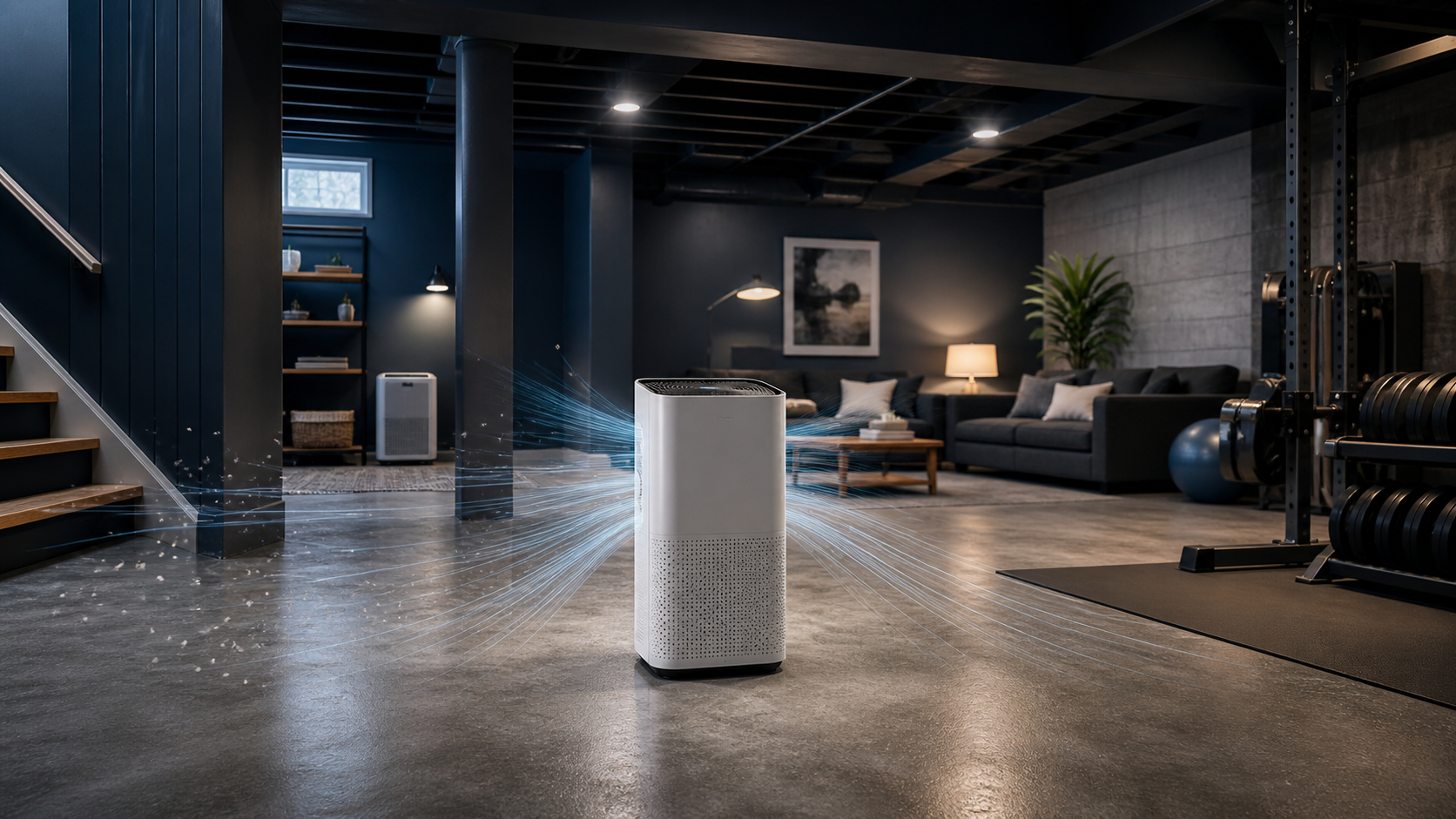
Basements present a unique challenge for indoor air quality. They are often subterranean, prone to humidity, and lack the natural ventilation found on higher floors.
Important Safety Note
Air purifiers are excellent at capturing airborne mold spores and neutralizing odors, but they do not fix water leaks, rising damp, or active mold growth. If you have a moisture problem, you must address the source first.
The "Basement Smell"
That familiar "musty" basement odor is typically caused by microbial volatile organic compounds (mVOCs) released by mold or mildew. To tackle these smells, a standard HEPA filter isn't enough. You need an air purifier with a substantial activated carbon filter. Carbon works through adsorption, trapping gas molecules and odors in its porous surface.
Mold Spores and Dust
Basements are often the dustiest parts of a home, especially if they are unfinished or used for storage. HEPA (High-Efficiency Particulate Air) filters are the gold standard for capturing mold spores and dust, which are relatively large particles. Ensuring your basement purifier has a certified True HEPA filter is essential.
Pairing with a Dehumidifier
In most basements, an air purifier should be the second line of defense, following a dehumidifier. By keeping humidity levels below 50%, you prevent mold from growing in the first place. The air purifier then works to clean up the existing particles and odors that remain.
Sizing for Large, Open Spaces
Basements are often large, open areas. This means you need a unit with a high CADR to move enough air through the entire space. If your basement is divided into rooms (e.g., a gym, a laundry room, and a media room), consider two smaller units instead of one giant one, as walls and doorways significantly block airflow.
Calculate Your Basement Needs
Input your basement's total volume into our calculator to see the CADR rating you need.
Use the Sizer →Placement Tips
Avoid placing your purifier in a dark, damp corner. For the best results in a basement:
- Central location: Place it in the middle of the main living area.
- Off the floor: If possible, place smaller units on a table to avoid picking up heavy floor dust immediately.
- Near the source: If you have a specific damp area or pet area, place the unit nearby to catch odors at the source.
FAQ
Will an air purifier kill mold?
No. Air purifiers capture airborne spores but do not kill mold growing on surfaces. To kill mold, you need to use appropriate cleaning agents and, most importantly, fix the moisture issue.
Does a basement purifier need a washable pre-filter?
Yes, highly recommended. Because basements are dustier, a washable pre-filter will catch the "big stuff," extending the life of your expensive HEPA filter.
Related Guides:
HEPA vs. Carbon Explained | Why Marketing Ratings Mislead