Definitive Guide
How to Size an Air Purifier by Room
If you buy an air purifier based on the "square footage" printed on the box, you are likely wasting your money. Here is how to actually size a purifier.
The vast majority of air purifier marketing relies on a fundamental misdirection. Brands want to put the largest possible number on the front of the box. To do this, they rate their machines based on best-case scenarios: running on the absolute highest, loudest fan speed, in a room with very low ceilings, achieving only one or two air changes per hour.
In reality, you don't live in a 2D square. You live in a 3D volume of air. And you probably don't want a machine that sounds like a jet engine running 24/7 in your bedroom.
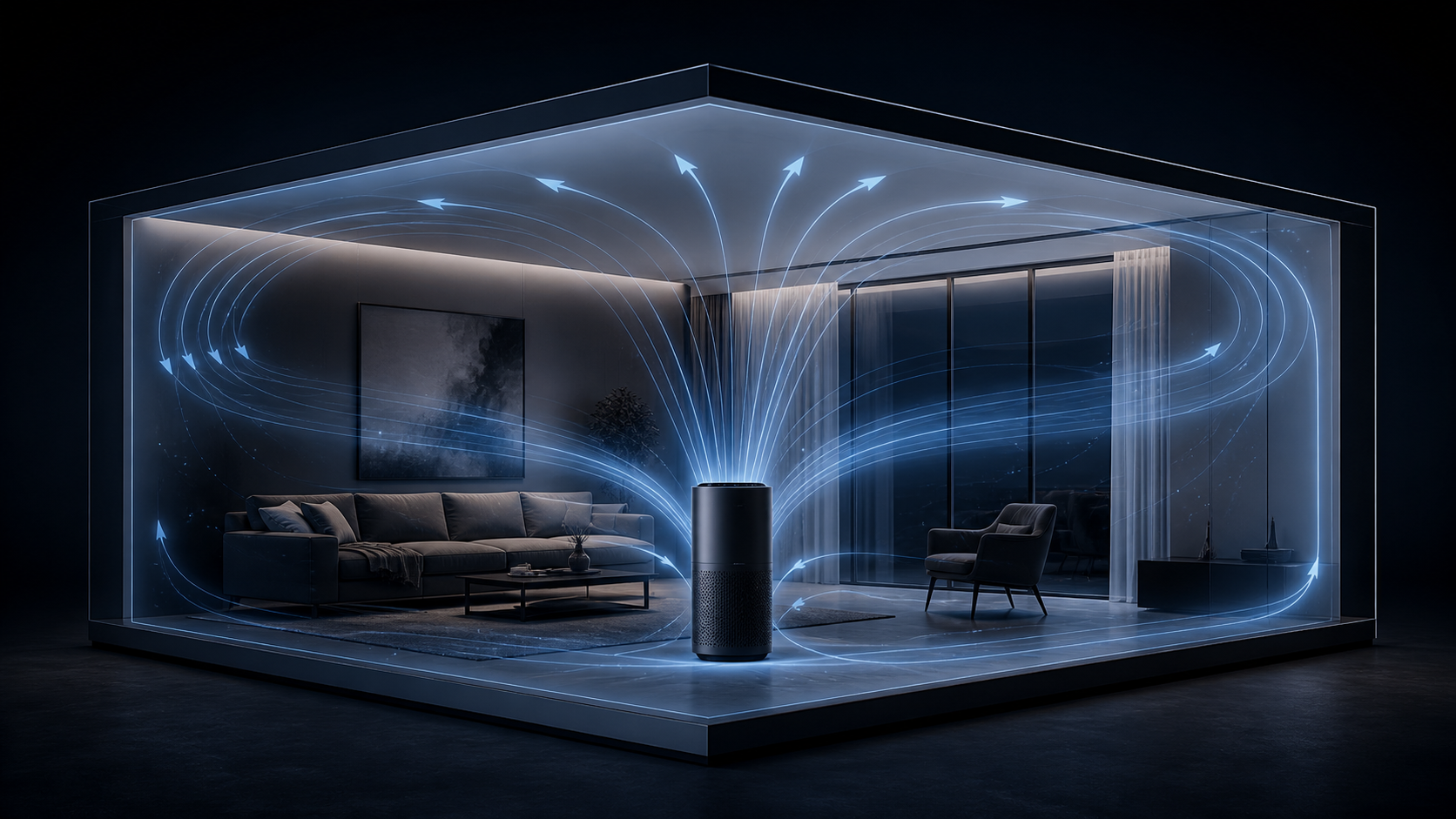
Step 1: Calculate Your Room Volume
Because air is three-dimensional, ceiling height is just as important as floor space. A 12×12 room with standard 8-foot ceilings holds 1,152 cubic feet of air. If that same room has 10-foot vaulted ceilings, it holds 1,440 cubic feet. That’s 25% more air to clean, meaning you need a 25% more powerful purifier.
The formula: Length (ft) × Width (ft) × Height (ft) = Room Volume (ft³).
Step 2: Determine Your Air Changes Per Hour (ACH)
Air Changes per Hour (ACH) is the number of times a purifier cycles all the air in a room through its filters in 60 minutes. This is the most critical metric for indoor air quality.
- 2 ACH: Bare minimum. Not recommended for most homes.
- 4 ACH: The standard recommendation for maintaining clean air.
- 5 ACH: The target for allergy sufferers (pollen, dust mites).
- 6 to 8 ACH: Necessary for wildfire smoke, heavy VOCs, or asthma-sensitive spaces.
Step 3: Calculate the Required CADR
CADR stands for Clean Air Delivery Rate. It is an independently verified metric (often tested by AHAM) that tells you exactly how many cubic feet of clean air the machine outputs per minute (CFM). This is the only number you should trust.
To find the CADR you need, you calculate the required CFM to hit your target ACH, and then apply a buffer so you don't have to run the machine on its loudest setting.
The math: (Room Volume × ACH) ÷ 60 = Required CFM.
We then multiply that Required CFM by a 1.55x buffer. This ensures the purifier can maintain your target ACH while running on a quiet medium speed.
Skip the Math
Don't want to calculate this by hand? Use our free tool to get your exact CADR requirement and see matched products instantly.
Open the Air Purifier SizerStep 4: Buy for the specific room, not the "whole house"
Air behaves like water. It pools in rooms, gets blocked by closed doors, and struggles to turn corners down long hallways. A single massive air purifier in the living room will do almost nothing for the air in a closed bedroom down the hall.
The most effective strategy is to buy right-sized units for individual rooms, prioritizing the rooms where you spend the most time (usually the bedroom).
Step 5: Check the Filter Type
Hitting the right CADR is essential, but the filter must match your concern:
- For particles (dust, pollen, smoke ash, dander): You need a True HEPA filter.
- For gases (VOCs, odors, smoke smell): You need a heavy activated carbon filter. A thin black carbon sheet is insufficient; look for models with pounds of carbon pellets.